Buy wmqv.com ?
We are moving the project
wmqv.com .
Are you interested in purchasing the domain
wmqv.com ?
domain@kv-gmbh.de · 0541-91531010
Buy wmqv.com ?
What is the ethics of technology?
The ethics of technology refers to the moral principles and guidelines that govern the development, use, and impact of technological advancements. It involves considering the potential benefits and risks of technology, as well as the implications for individuals, society, and the environment. Ethical considerations in technology include issues such as privacy, security, equality, and the responsible use of data and artificial intelligence. It also involves ensuring that technology is used in a way that respects human rights and promotes the well-being of all individuals. Ultimately, the ethics of technology seeks to ensure that technological advancements are developed and utilized in a way that aligns with ethical principles and values. **
Can you explain virtue ethics, duty ethics, and goods ethics?
Virtue ethics focuses on the character of the individual and emphasizes the development of virtuous traits such as honesty, courage, and compassion. It is concerned with cultivating moral excellence and living a good life. Duty ethics, also known as deontological ethics, is based on the idea that certain actions are inherently right or wrong, regardless of their consequences. It emphasizes the importance of following moral rules and fulfilling one's duties and obligations. Goods ethics, or consequentialism, evaluates the morality of an action based on its outcomes or consequences. It focuses on maximizing the overall good or happiness and considers the potential impact of an action on others. **


Similar search terms for Ethics
Top-Angebote
Products related to Ethics:
-
Apple AirPods Max 2 Wireless Over-Ear Headphones Starlight – Active Noise Cancellation, Adaptive Audio, Live Translation & Personalised Spatial Audio.gadcet-pdp{--g-green:#00a651;color:#1f2430;line-height:1.55;font-size:inherit;max-width:760px}.gadcet-pdp>*:first-child{margin-top:0}.gadcet-pdp p{margin:0 0.9em}.gadcet-pdp h3{font-size:1.05em;font-weight:600;color:#11161f;margin:1.4em 0.5em;padding-left:.5em;border-left:3px solid var(--g-green);border-radius:0;line-height:1.3}.gadcet-pdp ul{list-style:none!important;margin:0 0.9em;padding:0!important}.gadcet-pdp ul li{position:relative;padding:.1em 0.1em 1.5em;margin:0}.gadcet-pdp ul li::before{content:"";position:absolute;left:.16em;top:.45em;width:.36em;height:.66em;border:solid var(--g-green);border-width:0.14em.14em 0;transform:rotate(45deg)}.gadcet-pdp table{width:100%;border-collapse:collapse;margin:.3em 0 1em;font-size:.95em;border:1px solid #e7e9ee!important;border-radius:8px;overflow:hidden}.gadcet-pdp table td{padding:.5em.8em;border-bottom:1px solid #eef0f4!important;vertical-align:top}.gadcet-pdp table tr:last-child td{border-bottom:0!important}.gadcet-pdp table tr:nth-child(even){background:#f7f9f8}.gadcet-pdp table td:first-child{font-weight:600;color:#454c59;width:40%}@media (max-width:600px){.gadcet-pdp table td:first-child{width:42%}} Experience immersive Apple audio with the AirPods Max 2 Wireless Over-Ear Headphones in Starlight — built for focused listening, clearer calls and seamless everyday use with Active Noise Cancellation, Adaptive Audio and Personalised Spatial Audio. Key Features Active Noise Cancellation helps reduce unwanted background noise for more focused listening. Adaptive Audio intelligently blends noise control and awareness as your surroundings change. Personalised Spatial Audio with dynamic head tracking creates a more immersive soundstage for supported content. Live Translation support for real-time conversations across selected languages when paired with a compatible Apple Intelligence-enabled iPhone. Apple H2 headphone chip in each ear cup for intelligent audio processing and smooth Apple device use. Bluetooth 5.3 wireless technology for cable-free listening. USB-C charging, plus USB-C wired listening for lossless audio and ultra-low latency with compatible content and apps. Up to 20 hours of listening time with Active Noise Cancellation enabled. A 5-minute charge provides around 1.5 hours of listening time. Nine microphones support noise control and voice pickup for calls, meetings and voice commands. Benefits Stay immersed on commutes, flights, study sessions and busy workdays. Enjoy films, music and supported content with a wider, more cinematic feel. Move smoothly between compatible Apple devices such as iPhone, iPad and Mac. Brand new, ready to enjoy straight from the box. Specifications Brand Apple Model AirPods Max 2 Colour Starlight Type Wireless over-ear headphones Audio Features Active Noise Cancellation, Adaptive Audio, Transparency mode, Personalised Spatial Audio Chip Apple H2 headphone chip in each ear cup Microphones Nine microphones total Connectivity Bluetooth 5.3 wireless technology...467,00 £*Shipping: 0,00 £Secure redirect to the provider


-
Is Buddhist ethics comparable to Christian ethics?
Buddhist ethics and Christian ethics share some similarities, such as the emphasis on compassion, love, and non-violence. Both traditions also promote the idea of treating others with kindness and respect. However, there are also significant differences between the two, such as the concept of sin and salvation in Christianity, which is not present in Buddhism. Additionally, the role of divine authority and the concept of God differs between the two traditions. Overall, while there are some common ethical principles, the underlying beliefs and foundations of Buddhist and Christian ethics are distinct. **
-
Is Nicomachean Ethics the same as Virtue Ethics?
Nicomachean Ethics is a specific work by Aristotle that is considered one of the foundational texts in virtue ethics. While Nicomachean Ethics is a key text within the broader framework of virtue ethics, virtue ethics itself is a broader ethical theory that encompasses various other works and perspectives beyond just Aristotle's. So, while Nicomachean Ethics is a significant part of virtue ethics, they are not exactly the same thing. **
-
Does Kant's deontological ethics contradict Aristotle's eudaemonistic ethics?
Kant's deontological ethics and Aristotle's eudaemonistic ethics have some fundamental differences, but they do not necessarily contradict each other. Kant's ethics focus on duty and the intention behind actions, while Aristotle's ethics emphasize achieving eudaimonia, or human flourishing, through virtuous actions. While Kant's emphasis on duty can sometimes conflict with Aristotle's emphasis on virtue, both ethical theories ultimately aim to guide individuals towards leading a good and moral life. Therefore, while they may approach ethics from different perspectives, they can be seen as complementary rather than contradictory. **
-
Is responsibility ethics the same as future ethics?
Responsibility ethics and future ethics are related but not the same. Responsibility ethics focuses on the moral obligations and duties that individuals and organizations have in the present moment, while future ethics considers the ethical implications of our actions on future generations and the long-term consequences of our choices. While responsibility ethics emphasizes the immediate impact of our actions, future ethics considers the broader and long-term effects of our decisions on the well-being of future generations and the sustainability of the planet. Both are important aspects of ethical decision-making, but they address different time frames and perspectives. **

Does ethics still exist nowadays? Is ethics a problem?
Ethics still exist nowadays as a set of moral principles that guide human behavior and decision-making. However, there are instances where ethical considerations are overlooked or compromised in favor of personal gain or convenience, making ethics a problem in society. It is important for individuals and organizations to prioritize ethical behavior to maintain trust, integrity, and social responsibility. Efforts to promote ethical conduct through education, awareness, and accountability can help address ethical challenges in today's world. **
What is ethics?
Ethics is a branch of philosophy that deals with moral principles and values that govern individual behavior and decision-making. It involves distinguishing between right and wrong actions, as well as understanding the consequences of those actions on individuals and society as a whole. Ethics provides a framework for individuals to make ethical choices and behave in a morally responsible manner. It also helps in creating a sense of accountability and integrity in personal and professional relationships. **
Top-Angebote
Products related to Ethics:
-
Atlantic Books How Death Becomes Life: Notes from a Transplant Surgeon by Joshua Mezrich - Paperback - Medical Memoir & EthicsIn How Death Becomes Life, transplant surgeon Dr Joshua Mezrich takes readers deep inside the operating theatre, where split-second decisions determine who lives and who dies. Drawing on his career at the University of Wisconsin, Mezrich weaves the remarkable history of transplantation - from early, disastrous experiments to the present day. This memoir is a compelling read for anyone fascinated by medicine, ethics, or the extraordinary courage of doctors, donors, and families who make life-saving miracles possible. The paperback edition of this book is a detailed and intimate account of life inside the operating room, where Mezrich confronts the most profound ethical and human dilemmas in modern medicine. Blending more than a century of medical history with intimate patient stories, Mezrich reveals how organ transplantation transforms tragedy into hope.2,99 £*Shipping: 2,99 £Secure redirect to the provider
-
The Readers Paradise Counseling Skills For Managers by Prof. N.K. Daniel - Paperback - Leadership, Coaching & Workplace Ethics Guide for Managers and HR ProfessionalsCounseling Skills For Managers is a practical guide that helps leaders develop essential counseling skills for the workplace. Written for managers, team leads, HR professionals, and aspiring executives, it covers foundational counseling theory and its strategic application in corporate settings. The book teaches readers how to listen with empathy, structure coaching conversations, resolve role conflicts, and support colleagues through change and difficulty, all while maintaining clear ethical boundaries. This guide is a valuable addition to any professional development or leadership library, offering a unique blend of psychology and management principles in an accessible format.2,99 £*Shipping: 2,99 £Secure redirect to the provider
-
What is the ethics of technology?
The ethics of technology refers to the moral principles and guidelines that govern the development, use, and impact of technological advancements. It involves considering the potential benefits and risks of technology, as well as the implications for individuals, society, and the environment. Ethical considerations in technology include issues such as privacy, security, equality, and the responsible use of data and artificial intelligence. It also involves ensuring that technology is used in a way that respects human rights and promotes the well-being of all individuals. Ultimately, the ethics of technology seeks to ensure that technological advancements are developed and utilized in a way that aligns with ethical principles and values. **
-
Can you explain virtue ethics, duty ethics, and goods ethics?
Virtue ethics focuses on the character of the individual and emphasizes the development of virtuous traits such as honesty, courage, and compassion. It is concerned with cultivating moral excellence and living a good life. Duty ethics, also known as deontological ethics, is based on the idea that certain actions are inherently right or wrong, regardless of their consequences. It emphasizes the importance of following moral rules and fulfilling one's duties and obligations. Goods ethics, or consequentialism, evaluates the morality of an action based on its outcomes or consequences. It focuses on maximizing the overall good or happiness and considers the potential impact of an action on others. **
-
Is Buddhist ethics comparable to Christian ethics?
Buddhist ethics and Christian ethics share some similarities, such as the emphasis on compassion, love, and non-violence. Both traditions also promote the idea of treating others with kindness and respect. However, there are also significant differences between the two, such as the concept of sin and salvation in Christianity, which is not present in Buddhism. Additionally, the role of divine authority and the concept of God differs between the two traditions. Overall, while there are some common ethical principles, the underlying beliefs and foundations of Buddhist and Christian ethics are distinct. **
-
Is Nicomachean Ethics the same as Virtue Ethics?
Nicomachean Ethics is a specific work by Aristotle that is considered one of the foundational texts in virtue ethics. While Nicomachean Ethics is a key text within the broader framework of virtue ethics, virtue ethics itself is a broader ethical theory that encompasses various other works and perspectives beyond just Aristotle's. So, while Nicomachean Ethics is a significant part of virtue ethics, they are not exactly the same thing. **
Similar search terms for Ethics
-
Apple AirPods Max 2 Wireless Over-Ear Headphones Starlight – Active Noise Cancellation, Adaptive Audio, Live Translation & Personalised Spatial Audio.gadcet-pdp{--g-green:#00a651;color:#1f2430;line-height:1.55;font-size:inherit;max-width:760px}.gadcet-pdp>*:first-child{margin-top:0}.gadcet-pdp p{margin:0 0.9em}.gadcet-pdp h3{font-size:1.05em;font-weight:600;color:#11161f;margin:1.4em 0.5em;padding-left:.5em;border-left:3px solid var(--g-green);border-radius:0;line-height:1.3}.gadcet-pdp ul{list-style:none!important;margin:0 0.9em;padding:0!important}.gadcet-pdp ul li{position:relative;padding:.1em 0.1em 1.5em;margin:0}.gadcet-pdp ul li::before{content:"";position:absolute;left:.16em;top:.45em;width:.36em;height:.66em;border:solid var(--g-green);border-width:0.14em.14em 0;transform:rotate(45deg)}.gadcet-pdp table{width:100%;border-collapse:collapse;margin:.3em 0 1em;font-size:.95em;border:1px solid #e7e9ee!important;border-radius:8px;overflow:hidden}.gadcet-pdp table td{padding:.5em.8em;border-bottom:1px solid #eef0f4!important;vertical-align:top}.gadcet-pdp table tr:last-child td{border-bottom:0!important}.gadcet-pdp table tr:nth-child(even){background:#f7f9f8}.gadcet-pdp table td:first-child{font-weight:600;color:#454c59;width:40%}@media (max-width:600px){.gadcet-pdp table td:first-child{width:42%}} Experience immersive Apple audio with the AirPods Max 2 Wireless Over-Ear Headphones in Starlight — built for focused listening, clearer calls and seamless everyday use with Active Noise Cancellation, Adaptive Audio and Personalised Spatial Audio. Key Features Active Noise Cancellation helps reduce unwanted background noise for more focused listening. Adaptive Audio intelligently blends noise control and awareness as your surroundings change. Personalised Spatial Audio with dynamic head tracking creates a more immersive soundstage for supported content. Live Translation support for real-time conversations across selected languages when paired with a compatible Apple Intelligence-enabled iPhone. Apple H2 headphone chip in each ear cup for intelligent audio processing and smooth Apple device use. Bluetooth 5.3 wireless technology for cable-free listening. USB-C charging, plus USB-C wired listening for lossless audio and ultra-low latency with compatible content and apps. Up to 20 hours of listening time with Active Noise Cancellation enabled. A 5-minute charge provides around 1.5 hours of listening time. Nine microphones support noise control and voice pickup for calls, meetings and voice commands. Benefits Stay immersed on commutes, flights, study sessions and busy workdays. Enjoy films, music and supported content with a wider, more cinematic feel. Move smoothly between compatible Apple devices such as iPhone, iPad and Mac. Brand new, ready to enjoy straight from the box. Specifications Brand Apple Model AirPods Max 2 Colour Starlight Type Wireless over-ear headphones Audio Features Active Noise Cancellation, Adaptive Audio, Transparency mode, Personalised Spatial Audio Chip Apple H2 headphone chip in each ear cup Microphones Nine microphones total Connectivity Bluetooth 5.3 wireless technology...467,00 £*Shipping: 0,00 £Secure redirect to the provider
-
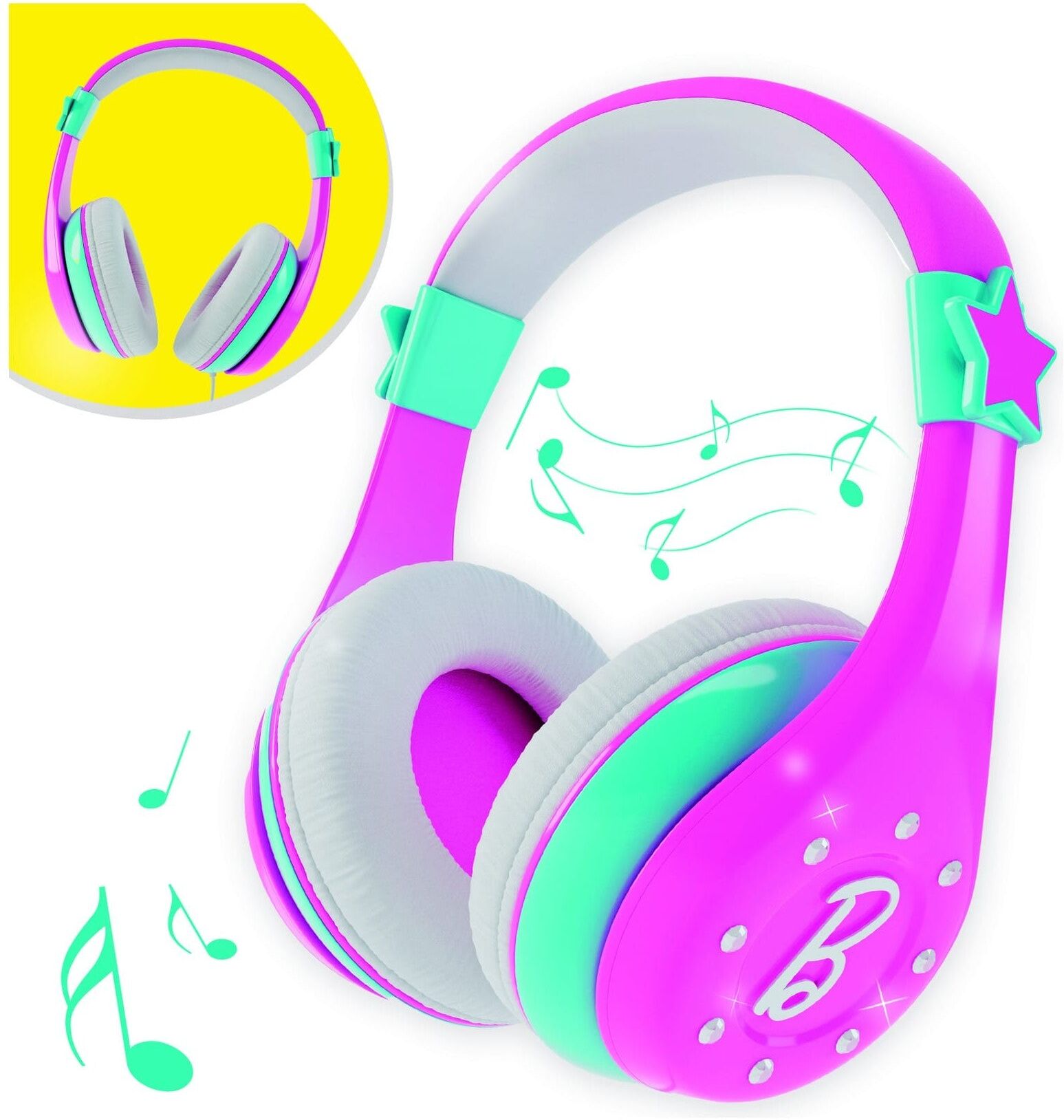
Lisciani Barbie Bluetooth Headphones for Kids, Kid-Friendly Wireless Audio, Ages Four and UpLisciani Barbie Bluetooth headphones bring kid-friendly wireless audio to playtime for children aged four and up. The Lisciani brand combines a trusted toy heritage with practical tech, delivering Bluetooth headphones designed for kids and easy for parents to trust. These headphones are designed for everyday adventures and feature a durable, lightweight construction that fuses Barbie-themed style with comfort. They're perfect for car rides, classroom activities, or quiet-time listening. The headphones pair with a smartphone or tablet in seconds and switch devices with ease. A safe volume limiter protects young hearing during hours of listening. The headphones have a lightweight, adjustable headband with soft, cushioned ear cups for all-day comfort. The Barbie-themed design is a familiar look that kids will love to wear. They're ideal for kids aged four and up.22,66 £*Shipping: 3,95 £Secure redirect to the provider
-
Lush Living Finds Perforated Brick Assembly Toy Accessories With Technology Mechanical Wheels Perforated Brick Assembly Toy Accessories With Technology Mechanical WheelsEnhance Creativity with Technology Mechanical Wheels Unlock the power of innovation with our technology mechanical wheels, designed specifically for perforated brick assembly toy accessories. Whether you are a hobbyist or a seasoned builder, these...43,97 $*Shipping: 0,00 $Secure redirect to the provider
-
Does Kant's deontological ethics contradict Aristotle's eudaemonistic ethics?
Kant's deontological ethics and Aristotle's eudaemonistic ethics have some fundamental differences, but they do not necessarily contradict each other. Kant's ethics focus on duty and the intention behind actions, while Aristotle's ethics emphasize achieving eudaimonia, or human flourishing, through virtuous actions. While Kant's emphasis on duty can sometimes conflict with Aristotle's emphasis on virtue, both ethical theories ultimately aim to guide individuals towards leading a good and moral life. Therefore, while they may approach ethics from different perspectives, they can be seen as complementary rather than contradictory. **
-
Is responsibility ethics the same as future ethics?
Responsibility ethics and future ethics are related but not the same. Responsibility ethics focuses on the moral obligations and duties that individuals and organizations have in the present moment, while future ethics considers the ethical implications of our actions on future generations and the long-term consequences of our choices. While responsibility ethics emphasizes the immediate impact of our actions, future ethics considers the broader and long-term effects of our decisions on the well-being of future generations and the sustainability of the planet. Both are important aspects of ethical decision-making, but they address different time frames and perspectives. **
-
Does ethics still exist nowadays? Is ethics a problem?
Ethics still exist nowadays as a set of moral principles that guide human behavior and decision-making. However, there are instances where ethical considerations are overlooked or compromised in favor of personal gain or convenience, making ethics a problem in society. It is important for individuals and organizations to prioritize ethical behavior to maintain trust, integrity, and social responsibility. Efforts to promote ethical conduct through education, awareness, and accountability can help address ethical challenges in today's world. **
-
What is ethics?
Ethics is a branch of philosophy that deals with moral principles and values that govern individual behavior and decision-making. It involves distinguishing between right and wrong actions, as well as understanding the consequences of those actions on individuals and society as a whole. Ethics provides a framework for individuals to make ethical choices and behave in a morally responsible manner. It also helps in creating a sense of accountability and integrity in personal and professional relationships. **
* All prices are inclusive of VAT and, if applicable, plus shipping costs. The offer information is based on the details provided by the respective shop and is updated through automated processes. Real-time updates do not occur, so deviations can occur in individual cases. ** Note: Parts of this content were created by AI.