Buy wmqv.com ?
We are moving the project
wmqv.com .
Are you interested in purchasing the domain
wmqv.com ?
domain@kv-gmbh.de · 0541-91531010
Buy wmqv.com ?
What is the difference between negotiating subject and negotiating basis?
Negotiating subject refers to the specific issue or topic that is being discussed or resolved during a negotiation, such as price, terms, or delivery schedule. On the other hand, negotiating basis refers to the underlying principles, values, or criteria that guide the negotiation process, such as fairness, mutual benefit, or trust. While the negotiating subject is the tangible aspect of the negotiation, the negotiating basis is the intangible foundation that shapes how the negotiation is conducted and the ultimate outcome. It is important for negotiators to align both the subject and basis in order to reach a successful agreement. **
'For negotiating or for debating?'
For negotiating, it is important to focus on finding common ground and reaching a mutually beneficial agreement. This involves active listening, understanding the other party's perspective, and being open to compromise. On the other hand, for debating, the goal is often to persuade others to your point of view through presenting strong arguments and evidence. This may involve more assertive communication and a focus on winning the argument rather than finding a compromise. Both negotiating and debating require effective communication skills, but the approach and goals are different. **


Similar search terms for Negotiating
Top-Angebote
Products related to Negotiating:
-
Apple AirPods Max 2 Wireless Over-Ear Headphones Starlight – Active Noise Cancellation, Adaptive Audio, Live Translation & Personalised Spatial Audio.gadcet-pdp{--g-green:#00a651;color:#1f2430;line-height:1.55;font-size:inherit;max-width:760px}.gadcet-pdp>*:first-child{margin-top:0}.gadcet-pdp p{margin:0 0.9em}.gadcet-pdp h3{font-size:1.05em;font-weight:600;color:#11161f;margin:1.4em 0.5em;padding-left:.5em;border-left:3px solid var(--g-green);border-radius:0;line-height:1.3}.gadcet-pdp ul{list-style:none!important;margin:0 0.9em;padding:0!important}.gadcet-pdp ul li{position:relative;padding:.1em 0.1em 1.5em;margin:0}.gadcet-pdp ul li::before{content:"";position:absolute;left:.16em;top:.45em;width:.36em;height:.66em;border:solid var(--g-green);border-width:0.14em.14em 0;transform:rotate(45deg)}.gadcet-pdp table{width:100%;border-collapse:collapse;margin:.3em 0 1em;font-size:.95em;border:1px solid #e7e9ee!important;border-radius:8px;overflow:hidden}.gadcet-pdp table td{padding:.5em.8em;border-bottom:1px solid #eef0f4!important;vertical-align:top}.gadcet-pdp table tr:last-child td{border-bottom:0!important}.gadcet-pdp table tr:nth-child(even){background:#f7f9f8}.gadcet-pdp table td:first-child{font-weight:600;color:#454c59;width:40%}@media (max-width:600px){.gadcet-pdp table td:first-child{width:42%}} Experience immersive Apple audio with the AirPods Max 2 Wireless Over-Ear Headphones in Starlight — built for focused listening, clearer calls and seamless everyday use with Active Noise Cancellation, Adaptive Audio and Personalised Spatial Audio. Key Features Active Noise Cancellation helps reduce unwanted background noise for more focused listening. Adaptive Audio intelligently blends noise control and awareness as your surroundings change. Personalised Spatial Audio with dynamic head tracking creates a more immersive soundstage for supported content. Live Translation support for real-time conversations across selected languages when paired with a compatible Apple Intelligence-enabled iPhone. Apple H2 headphone chip in each ear cup for intelligent audio processing and smooth Apple device use. Bluetooth 5.3 wireless technology for cable-free listening. USB-C charging, plus USB-C wired listening for lossless audio and ultra-low latency with compatible content and apps. Up to 20 hours of listening time with Active Noise Cancellation enabled. A 5-minute charge provides around 1.5 hours of listening time. Nine microphones support noise control and voice pickup for calls, meetings and voice commands. Benefits Stay immersed on commutes, flights, study sessions and busy workdays. Enjoy films, music and supported content with a wider, more cinematic feel. Move smoothly between compatible Apple devices such as iPhone, iPad and Mac. Brand new, ready to enjoy straight from the box. Specifications Brand Apple Model AirPods Max 2 Colour Starlight Type Wireless over-ear headphones Audio Features Active Noise Cancellation, Adaptive Audio, Transparency mode, Personalised Spatial Audio Chip Apple H2 headphone chip in each ear cup Microphones Nine microphones total Connectivity Bluetooth 5.3 wireless technology...467,00 £*Shipping: 0,00 £Secure redirect to the provider
-
Lisciani Barbie Bluetooth Headphones for Kids, Kid-Friendly Wireless Audio, Ages Four and UpLisciani Barbie Bluetooth headphones bring kid-friendly wireless audio to playtime for children aged four and up. The Lisciani brand combines a trusted toy heritage with practical tech, delivering Bluetooth headphones designed for kids and easy for parents to trust. These headphones are designed for everyday adventures and feature a durable, lightweight construction that fuses Barbie-themed style with comfort. They're perfect for car rides, classroom activities, or quiet-time listening. The headphones pair with a smartphone or tablet in seconds and switch devices with ease. A safe volume limiter protects young hearing during hours of listening. The headphones have a lightweight, adjustable headband with soft, cushioned ear cups for all-day comfort. The Barbie-themed design is a familiar look that kids will love to wear. They're ideal for kids aged four and up.23,59 £*Shipping: 3,95 £Secure redirect to the provider



-
Why are Turks so good at negotiating?
Turks are known for their strong negotiation skills due to their cultural values that emphasize hospitality, respect, and building relationships. They are skilled at building rapport and establishing trust with their counterparts, which is essential in successful negotiations. Additionally, Turks are known for their adaptability and creativity in finding mutually beneficial solutions during negotiations. Their ability to think on their feet and their strong communication skills also contribute to their effectiveness in negotiations. **
-
Do you have to make compromises when negotiating?
Yes, making compromises is often necessary when negotiating. Both parties involved in a negotiation typically have different priorities and objectives, so finding a middle ground often requires making concessions. Compromises can help to build trust and goodwill between the parties, and ultimately lead to a mutually beneficial agreement. However, it's important to carefully consider which compromises are acceptable and to ensure that the final agreement aligns with your overall goals and values. **
-
Was there a bluff in negotiating the salary?
No, there was no bluff in negotiating the salary. Both parties were transparent and honest in their discussions, leading to a fair and mutually beneficial agreement. Open communication and honesty are essential in salary negotiations to build trust and maintain a positive relationship between the employer and the employee. **
-
Is there a difference between bargaining and negotiating?
Bargaining and negotiating are similar in that they both involve discussions and compromise to reach an agreement. However, bargaining typically involves a more competitive and confrontational approach, with each party trying to get the best deal for themselves. Negotiating, on the other hand, tends to be more collaborative and focused on finding a mutually beneficial solution. In bargaining, there may be more emphasis on haggling over specific terms, while negotiating often involves a broader discussion of interests and priorities. **

Is there a difference between haggling and bargaining/negotiating?
Haggling typically involves a more aggressive and confrontational approach to negotiating a price, often with the goal of getting the best deal possible. Bargaining or negotiating, on the other hand, involves a more collaborative and mutually beneficial process where both parties work together to reach a fair agreement. While both haggling and bargaining involve discussing prices and terms, the main difference lies in the tone and approach used during the negotiation process. **
What salary can I demand after my training when negotiating?
When negotiating your salary after training, it's important to consider factors such as your level of experience, the industry standards for your role, and the specific skills and knowledge you bring to the table. Research the average salary for your position in your location and use that as a benchmark. Additionally, highlight any additional certifications or achievements you've gained during your training to demonstrate your value to the company. Be prepared to negotiate and be flexible, but also be confident in advocating for a fair and competitive salary based on your qualifications and the value you bring to the organization. **
Top-Angebote
Products related to Negotiating:
-
Penguin Never Split the Difference: Negotiating as if Your Life Depended on ItA former FBI hostage negotiator offers a new, field-tested approach to - effective in any situation.'Riveting' Adam Grant'Stupendous' The Week'Brilliant' GuardianAfter a stint policing the rough streets of Kansas City, Missouri, Chris Voss joined the FBI, where his career as a kidnapping negotiator brought him face-to-face with bank robbers, gang leaders and terrorists. Never Split the Difference takes you inside his world of high-stakes negotiations, revealing the nine key principles that helped Voss and his colleagues succeed when it mattered the most - when people's lives were at stake.Rooted in the real-life experiences of an intelligence professional at the top of his game, Never Split the Difference will give you the competitive edge in any discussion. PRAISE FOR NEVER SPLIT THE DIFFERENCE'My pick for book of the year.' Forbes'Who better to learn [negotiation] from than Chris Voss, whose skills have saved lives and averted disaster?' Daily Mail'Filled with insights that apply to everyday negotiations.' Business Insider'It's rare that a book is so gripping and entertaining while still being actionable and applicable.' Inc.'A business book you won't be able to put down.' Fortune7,99 £*Shipping: 2,99 £Secure redirect to the provider
-
What is the difference between negotiating subject and negotiating basis?
Negotiating subject refers to the specific issue or topic that is being discussed or resolved during a negotiation, such as price, terms, or delivery schedule. On the other hand, negotiating basis refers to the underlying principles, values, or criteria that guide the negotiation process, such as fairness, mutual benefit, or trust. While the negotiating subject is the tangible aspect of the negotiation, the negotiating basis is the intangible foundation that shapes how the negotiation is conducted and the ultimate outcome. It is important for negotiators to align both the subject and basis in order to reach a successful agreement. **
-
'For negotiating or for debating?'
For negotiating, it is important to focus on finding common ground and reaching a mutually beneficial agreement. This involves active listening, understanding the other party's perspective, and being open to compromise. On the other hand, for debating, the goal is often to persuade others to your point of view through presenting strong arguments and evidence. This may involve more assertive communication and a focus on winning the argument rather than finding a compromise. Both negotiating and debating require effective communication skills, but the approach and goals are different. **
-
Why are Turks so good at negotiating?
Turks are known for their strong negotiation skills due to their cultural values that emphasize hospitality, respect, and building relationships. They are skilled at building rapport and establishing trust with their counterparts, which is essential in successful negotiations. Additionally, Turks are known for their adaptability and creativity in finding mutually beneficial solutions during negotiations. Their ability to think on their feet and their strong communication skills also contribute to their effectiveness in negotiations. **
-
Do you have to make compromises when negotiating?
Yes, making compromises is often necessary when negotiating. Both parties involved in a negotiation typically have different priorities and objectives, so finding a middle ground often requires making concessions. Compromises can help to build trust and goodwill between the parties, and ultimately lead to a mutually beneficial agreement. However, it's important to carefully consider which compromises are acceptable and to ensure that the final agreement aligns with your overall goals and values. **
Similar search terms for Negotiating
-
Apple AirPods Max 2 Wireless Over-Ear Headphones Starlight – Active Noise Cancellation, Adaptive Audio, Live Translation & Personalised Spatial Audio.gadcet-pdp{--g-green:#00a651;color:#1f2430;line-height:1.55;font-size:inherit;max-width:760px}.gadcet-pdp>*:first-child{margin-top:0}.gadcet-pdp p{margin:0 0.9em}.gadcet-pdp h3{font-size:1.05em;font-weight:600;color:#11161f;margin:1.4em 0.5em;padding-left:.5em;border-left:3px solid var(--g-green);border-radius:0;line-height:1.3}.gadcet-pdp ul{list-style:none!important;margin:0 0.9em;padding:0!important}.gadcet-pdp ul li{position:relative;padding:.1em 0.1em 1.5em;margin:0}.gadcet-pdp ul li::before{content:"";position:absolute;left:.16em;top:.45em;width:.36em;height:.66em;border:solid var(--g-green);border-width:0.14em.14em 0;transform:rotate(45deg)}.gadcet-pdp table{width:100%;border-collapse:collapse;margin:.3em 0 1em;font-size:.95em;border:1px solid #e7e9ee!important;border-radius:8px;overflow:hidden}.gadcet-pdp table td{padding:.5em.8em;border-bottom:1px solid #eef0f4!important;vertical-align:top}.gadcet-pdp table tr:last-child td{border-bottom:0!important}.gadcet-pdp table tr:nth-child(even){background:#f7f9f8}.gadcet-pdp table td:first-child{font-weight:600;color:#454c59;width:40%}@media (max-width:600px){.gadcet-pdp table td:first-child{width:42%}} Experience immersive Apple audio with the AirPods Max 2 Wireless Over-Ear Headphones in Starlight — built for focused listening, clearer calls and seamless everyday use with Active Noise Cancellation, Adaptive Audio and Personalised Spatial Audio. Key Features Active Noise Cancellation helps reduce unwanted background noise for more focused listening. Adaptive Audio intelligently blends noise control and awareness as your surroundings change. Personalised Spatial Audio with dynamic head tracking creates a more immersive soundstage for supported content. Live Translation support for real-time conversations across selected languages when paired with a compatible Apple Intelligence-enabled iPhone. Apple H2 headphone chip in each ear cup for intelligent audio processing and smooth Apple device use. Bluetooth 5.3 wireless technology for cable-free listening. USB-C charging, plus USB-C wired listening for lossless audio and ultra-low latency with compatible content and apps. Up to 20 hours of listening time with Active Noise Cancellation enabled. A 5-minute charge provides around 1.5 hours of listening time. Nine microphones support noise control and voice pickup for calls, meetings and voice commands. Benefits Stay immersed on commutes, flights, study sessions and busy workdays. Enjoy films, music and supported content with a wider, more cinematic feel. Move smoothly between compatible Apple devices such as iPhone, iPad and Mac. Brand new, ready to enjoy straight from the box. Specifications Brand Apple Model AirPods Max 2 Colour Starlight Type Wireless over-ear headphones Audio Features Active Noise Cancellation, Adaptive Audio, Transparency mode, Personalised Spatial Audio Chip Apple H2 headphone chip in each ear cup Microphones Nine microphones total Connectivity Bluetooth 5.3 wireless technology...467,00 £*Shipping: 0,00 £Secure redirect to the provider
-
Lisciani Barbie Bluetooth Headphones for Kids, Kid-Friendly Wireless Audio, Ages Four and UpLisciani Barbie Bluetooth headphones bring kid-friendly wireless audio to playtime for children aged four and up. The Lisciani brand combines a trusted toy heritage with practical tech, delivering Bluetooth headphones designed for kids and easy for parents to trust. These headphones are designed for everyday adventures and feature a durable, lightweight construction that fuses Barbie-themed style with comfort. They're perfect for car rides, classroom activities, or quiet-time listening. The headphones pair with a smartphone or tablet in seconds and switch devices with ease. A safe volume limiter protects young hearing during hours of listening. The headphones have a lightweight, adjustable headband with soft, cushioned ear cups for all-day comfort. The Barbie-themed design is a familiar look that kids will love to wear. They're ideal for kids aged four and up.23,59 £*Shipping: 3,95 £Secure redirect to the provider
-
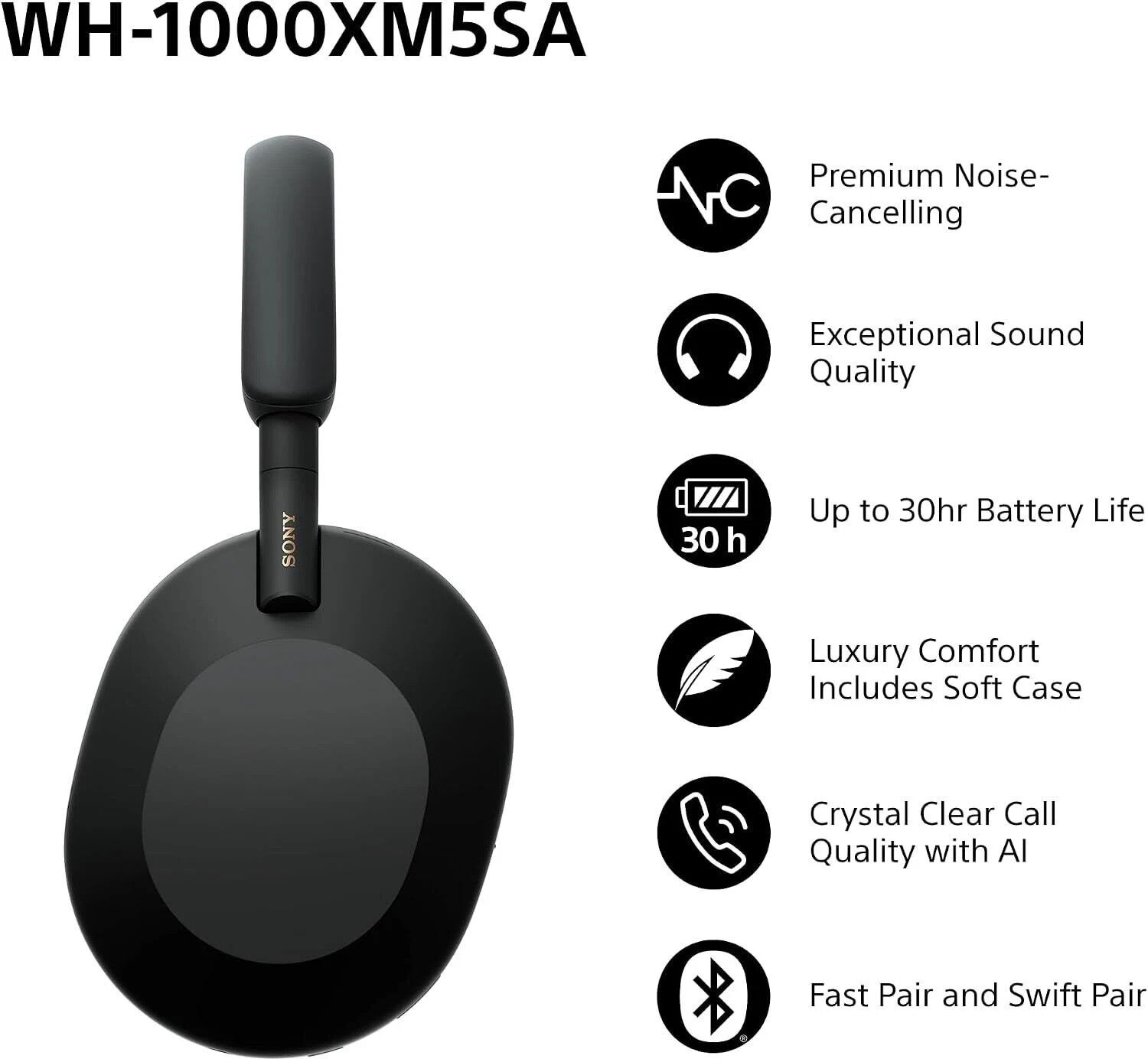
Sony WH-1000XM5SA Special Edition Wireless Noise Cancelling Over-Ear Headphones Bluetooth Hi-Res Audio - BlackThe Sony WH-1000XM5SA Special Edition delivers premium wireless audio with Sony's advanced noise cancelling technology, designed to provide an immersive listening experience in busy environments. The Special Edition includes a matching soft carrying case for convenient storage and portability. Featuring Sony's HD Noise Cancelling Processor QN1 and Integrated Processor V1, the headphones use multiple microphones and Auto NC Optimizer to automatically optimise noise cancellation based on your surroundings and wearing conditions. Ambient Sound Mode and Quick Attention make it easy to stay aware of your surroundings when needed. The specially developed 30mm drivers deliver detailed, high-resolution sound, while LDAC support provides High-Resolution Audio Wireless playback. DSEE Extreme technology can also restore detail to compressed digital music files for a richer listening experience. Precise Voice Pickup Technology uses four beamforming microphones and AI-based noise reduction to provide clear calls, while multipoint Bluetooth allows connection to two devices simultaneously. With up to 30 hours of battery life with noise cancelling enabled and quick charging support, the WH-1000XM5SA is well suited to travel, work and everyday listening.173,49 £*Shipping: 0,00 £Secure redirect to the provider
-
Lush Living Finds Perforated Brick Assembly Toy Accessories With Technology Mechanical Wheels Perforated Brick Assembly Toy Accessories With Technology Mechanical WheelsEnhance Creativity with Technology Mechanical Wheels Unlock the power of innovation with our technology mechanical wheels, designed specifically for perforated brick assembly toy accessories. Whether you are a hobbyist or a seasoned builder, these...43,97 $*Shipping: 0,00 $Secure redirect to the provider
-
Was there a bluff in negotiating the salary?
No, there was no bluff in negotiating the salary. Both parties were transparent and honest in their discussions, leading to a fair and mutually beneficial agreement. Open communication and honesty are essential in salary negotiations to build trust and maintain a positive relationship between the employer and the employee. **
-
Is there a difference between bargaining and negotiating?
Bargaining and negotiating are similar in that they both involve discussions and compromise to reach an agreement. However, bargaining typically involves a more competitive and confrontational approach, with each party trying to get the best deal for themselves. Negotiating, on the other hand, tends to be more collaborative and focused on finding a mutually beneficial solution. In bargaining, there may be more emphasis on haggling over specific terms, while negotiating often involves a broader discussion of interests and priorities. **
-
Is there a difference between haggling and bargaining/negotiating?
Haggling typically involves a more aggressive and confrontational approach to negotiating a price, often with the goal of getting the best deal possible. Bargaining or negotiating, on the other hand, involves a more collaborative and mutually beneficial process where both parties work together to reach a fair agreement. While both haggling and bargaining involve discussing prices and terms, the main difference lies in the tone and approach used during the negotiation process. **
-
What salary can I demand after my training when negotiating?
When negotiating your salary after training, it's important to consider factors such as your level of experience, the industry standards for your role, and the specific skills and knowledge you bring to the table. Research the average salary for your position in your location and use that as a benchmark. Additionally, highlight any additional certifications or achievements you've gained during your training to demonstrate your value to the company. Be prepared to negotiate and be flexible, but also be confident in advocating for a fair and competitive salary based on your qualifications and the value you bring to the organization. **
* All prices are inclusive of VAT and, if applicable, plus shipping costs. The offer information is based on the details provided by the respective shop and is updated through automated processes. Real-time updates do not occur, so deviations can occur in individual cases. ** Note: Parts of this content were created by AI.